Do you have a plan?

How far into the future should we plan for?  Days, months, years perhaps?  John Lennon said, “Life is what happens while you are busy making other plans.”

A couple of months at most

Don’t bother making plans that exceed several months at most.  This precious advice (which was, incidentally, given to me) is best because:  change is the only constant.

Don’t be disappointed

If you plan ahead no more than, say, two months, you won’t be disappointed if things don’t go according to plan.

Plan B

Although Plan A is wonderful and makes your heart “sing,” don’t forget to tuck away Plan B.  Although you wish for, dream about, long for and can’t picture life without Plan A, keep Plan B in your “pocket” just in case.

Although we may have a perfectly clear vision of where we’d like to be five years from  now and that this vision may, in fact, be realized, unpredictable, unforeseeable events can and often do happen–especially when we least expect them.

Expect the unexpected

This is why it’s important to limit ourselves when planning.  We just don’t know what life will bring.  Perhaps it’s best, therefore, to expect the unexpected.

Flexibility in the face of change

How do you deal with a plan change?  What will you do if–for reasons that are entirely outside of your purview–Plan A fails?  The reason we need to have an alternate plan or plans is to be able to face life changes with flexibility.  Becoming entrenched in a favorite outcome and seeing that outcome suddenly become unattainable is painful yet should make us more flexible.

Realistic expectations

When we make plans, our expectations should be realistic.

Attainable goals

Set goals you can actually attain.

Pragmatic permutations

When you’re thinking strategically, think like a pragmatist.  “Pragma” means “thing” in modern Greek.  So, think “thingy” as opposed to “iffy.”  Be fully confident that what you deeply think about and long for will be yours; yet don’t pre-concretize exactly how it will happen.  Don’t rigidly determine ahead of time how the plan will pan out.

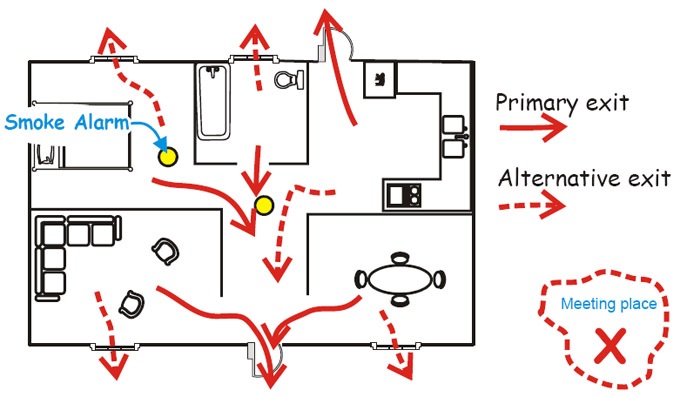
Plan

Image source:  manheimtownship.org

Reality is in the Detail

How much attention do you pay to your environment?  Do you notice what’s happening around you?  How careful are you regarding details pertaining to, for example, your job?

Pay attention

Many people go about their daily business as if they wore blinders.  They focus on a goal yet ignore everything else.  It’s as if nothing existed but their singular aim with the rest of the world meaning next to nothing.  This is not the right approach to take because:  details do matter.

Lost opportunities

Glossing over important details means that you will lose golden opportunities.  Your understanding will be diminished; you will be more rigid and less flexible; your capacity to enjoy life will be curtailed; and you will miss out on life-transforming knowledge.

Intricate interconnectedness

We are not isolated beings single-mindedly following personal agendas.  We are socially-interconnected beings whose behavior affects everyone and everything around us.

High-definition reality

In order to fully experience the richness of our existence, we need to stop “blindly” pursuing limited, personal gain.  Our gain will come in full when we admit that we are interwoven into the social fabric.

The 5 steps to seeing detail and increasing awareness

  1. Observe  Your ability to observe (whether documents, people or situations) will increase your acumen.  The power of observation (i.e., paying attention to minutiae) will draw you closer to reality.
  2. Remember the details you see  After observing important details, write notes to help you remember what you’ve seen.  You could, for example, keep a work-related journal and use dates and times to record matters of importance.
  3. Incorporate what you’ve seen  As you re-read your journal entries or notes, remember the details you described using the written word in your mind’s eye.  This will increase your ability to:  connect with the world around you; develop your memory; and, ultimately, improve your work performance.
  4. Understand the relevance of detail  When you read your journal, you will realize the high degree to which people and events are interconnected; where you belong in the story; and the great importance of minutiae in all things.
  5. Enjoy your new, heightened awareness  It would not be an exaggeration to say that paying attention increases awareness.  Paying attention to the details (e.g., of your job) will enhance your ability to hear and see; focus; and make connections that will increase your awareness and, in turn, result in benefits.

Details

The Big Change You’ve Been Dreaming Of

Do you feel stuck where you are?  Unappreciated perhaps?  Are the pressures and problems of life weighing down on you?  If so, understand:  It doesn’t have to be like this.  There is a way out.

You are the way

The first thing to grasp is that you need to desire change before it can happen.  Only you know what you truly, deeply desire.

Motivation

You’re going to have to motivate yourself from within–draw from inner resources–to change your outward circumstances.

Target

Pick a place and setting where you’d like to be.  If you don’t do this, nothing will happen.

Focus

Focus on what you do best.  This is the quality everyone raves about most.  “Joe is so good at ________________________.”  (Fill in the blank.)  Doing so will enable you to grasp what you should be doing as opposed to what you’re doing.

Believe

You must believe that a big life change is possible.  Believing opens the door for possibilities to materialize.  Your new belief in yourself must be expressed in thoughts and words.

Take measured steps

Once you’re motivated, focused on your target and believe you can make the big change, take the necessary steps.  Writing down your priorities will help.

Success is inevitable

If you follow the above steps, the big change you’ve been dreaming about will happen.

Change

Image source:  freedomquest.ca

Grow Your Talent

As I browsed the Internet, while researching a completely unrelated topic (.xml files), I chanced upon Sean Hyman’s The Biblical Money Code. 1

The advertisement for this video was well presented, peaked my interest, and I started watching.  Soon enough, I was hooked, taking notes even as I absorbed the material.

Hyman, an investment expert and former pastor, posits that if we want to obtain, in his words, “a blessing of practical wealth that goes far beyond [our] own needs or wants,” we need to stop loving money.

What’s the love of money?

According to Hyman, the love of money means that you love it so much that you’ll risk all the money you have in an ill-advised manner in order to get more; or, alternatively, that you love it so much that you’ll hold onto it for fear of losing what you have.  Hyman condemns both approaches.

The Parable of the Talents

The investor uses the Parable of the Talents 2 to make his point.  In this old story, before going on a long trip, a master gives (according to their abilities) five talents to one servant, two to another and one to a third.  Each talent represents twenty years of wages–a lot of money.  The first two servants trade their talents and, when the master eventually returns, give him double what he entrusted to them.  The third servant, though, justifies himself by saying, “I knew you were a tough guy, winning effortlessly and getting rewards painlessly.  I was afraid of you, so I hid the talent you gave me.  Here, take what’s yours.” 3

As happy and satisfied as the master is with the first two servants, he is furious and utterly dissatisfied with the third.  He takes away this servant’s talent and gives it to the first servant (who turned five into ten) and condemns the third servant saying, “You lazy, no good servant, you could have at least put my money in the bank and given me interest.” 4

What’s a talent?  Or, what is talent?

The word talent can mean “a unit of money equal to the value of a talent of gold or silver” or “general ability or intelligence.” 5  If we interpret the story allegorically, then we can say that by not trading (exchanging) our abilities with others, we are not growing and have squandered potential that was given us.

Hyman asks, and I’m paraphrasing, “What’s so bad about giving back the one talent the master gave him to begin with?  Why such a harsh response?”

Lost opportunities

They say that opportunities only come once.  If you don’t grab an opportunity, you risk losing it forever.  If your talents (gold, silver, cash) are stashed away, though, or you’re keeping your natural abilities under wraps, you’ve definitely squandered your potential–as well as the potential of others.

Potential

According to Hyman, the problem with hiding talent is squandering potential.  By hiding the talent, twenty years of wages couldn’t grow.  There was no trading, no exchange and no possibility for increase.  It was an expensive asset that lay idle for a very long time.

Money, according to the investment expert, needs to be invested and put to work.  We mustn’t let fear or the love of money stop us from:  stepping out (i.e., taking mitigated risks that will lead to stable and reliable returns); looking well into the matter of investment (like King Solomon, formerly the richest man on earth); and doing what’s needed to grow our talents.

Buck the trend

Sean Hyman cites two examples of very rich men who built their fortunes by doing the exact opposite of what others were doing.

Warren Buffett, one of the four richest people on earth, with an estimated net worth of fifty-three billion dollars said, “Be fearful when others are greedy and be greedy when others are fearful.” 6

Sir John Templeton, founder of the Templeton Prize said, “The time of maximum pessimism is the best time to buy, and the time of maximum optimism is the best time to sell.” 7

Image

Image:  CludiusII(CNG).jpg

Author:  Ssolbergj

References

1 Hyman, Sean. The Biblical Money Code. Accessed on Wednesday, August 14, 2013. http://w3.newsmax.com/newsletters/uwr/video_money_code_intl.cfm?promo_code=146F3-1

2 Matthew 25:14-30, KJV.

3 Ibid., verses 24-25, my interpretation.

4 Ibid., verses 26-27.

5 “Talent.” The Penguin Dictionary. Second edition. London: The Penguin Group, 2003.

6 See footnote 1.

7 Ibid.
The 10 Keys to Happiness

  1. Do something nice for someone  When we do nice things for people, we feel good.
  2. Be harmonious     Although achieving this state (and maintaining it) is not as easy as it sounds, avoiding the ‘push-pulls’ of extremes is key.
  3. Give     The old maxim, ‘give and you’ll receive’ is true.  When we give–even if we feel the other may not deserve our generosity–the boomerang factor kicks in and we receive.
  4. Be patient     Understand that the best things in life take time.  Trying to ‘manufacture’ happiness is a waste of your precious time.  Resist the temptation and be patient instead.
  5. Forget     That nasty divorce?  The time you accidentally left your hand on the doorjamb and someone closed the door?  Forget those bad memories and build new, positive ones.
  6. Overcome fear     One of the biggest stoppers to being happy is being afraid.  Don’t be afraid.  Everything, no matter how bad, works out in the end.
  7. Gratitude     When we are grateful for the bounty we’ve received and feel blessed without measure, we need to say ‘thank you.’
  8. Get out in nature     Nature is a very powerful, healing force.  I walked in a forest the other day and felt an unspeakable stillness that re-energized me completely.
  9. Exercise     I like to swim.  After a good swim, I feel happy!
  10. Acknowledge difficulty     Recognize that there will be difficult moments.  Remembering, though, that they’re just moments will get you through.

Image

Untitled, by Luba Rascheff

The10 Keys to Success

  1. Positive thinking     In order to make our dreams come true, we need to think positively.  It’s vital that we reject negative thoughts, ours or others’.
  2. Clear focus     Do you have a goal?  Keep it in the forefront of your mind.  As you perform the necessary steps toward reaching your stated objective, always remember to keep your goal first and foremost.
  3. Envision the desired result     If you know what you want most, where you want to be, visualize it.  Look at the situation or goal in your mind’s eye as if it had already happened.
  4. Steady as she goes     Refuse to be bothered by naysayers.  Continue on your chosen path knowing that it will lead to the success you’re dreaming of.
  5. Open the door     Success is like a door.  In order to reach it, you must turn the handle and open the door.  This will involve taking calculated risks.
  6. Don’t give up     Although there may be obstacles on the road to success, don’t get discouraged.  When this happen, revisit keys 1 and 3.
  7. Believe in the moment     Believe that, as you practice the above keys or, steps, that you are exactly where you should be at this very moment, regardless of anything contrary.
  8. Take needed breaks     Without the necessary rest and relaxation, you may break down.  A certain amount of indulging is required.
  9. Be grateful     While moving toward our most cherished goal, gratitude is imperative.  We need to thank the people who help us along.
  10. Accept success     In order to be successful, we need to accept success when it comes.  We need to believe in ourselves, that we are worthy of success.